






Electronegativity
Periodic Properties of Class 11
It may be defined as the tendency of an atom to attract shared pair of electrons towards itself in a covalently bonded molecules. The numerical value of the electronegativity of an element depends upon its ionization potential and electron affinity values. Higher ionization potential and higher electron affinity values implies higher electronegativity value.
ELECTRONEGATIVITY SCALES
The relative tendency of an atom to attract the shared electron pair towards itself is called electronegativity. This is the property of a bonded atom.
Some arbitrary scales for the quantitative measurement of electronegativities are as under
- Pauling's scale: Pauling related the resonance energy (Δ)AB of a molecule AB with the electronegativities of the atoms A and B. If xA and xB are the electronegativities of atoms A and B respectively then
0.208 √ΔAB = xA – xB if xA > xB
or 0.043 ΔAB = 23.06 (xA – x-B)2
ΔAB = EA-B(experimental) – EA-B(theoretical) where EA-B is the energy of A-B bond. In a purely covalent molecule, AB, the experimental and theoretical values of bond energy A-B are equal.
So ΔAB = 0
or 0=23.06 (xA – xB)2
or xA = xB
In an ionic molecule AB, EA-B(experimental) is more than EA-B(Theoretical).
Pauling assumed the electronegativity value of fluorine to be 4 and calculated the electronegativity values of other elements from this value.
- Mulliken's electronegativity: According to Mulliken, the electronegativity of an element is the average value of its ionization potential and electron affinity.

Mulliken's electronegativity (xM) – 0.615)
or xp = 0.336 xM – 0.2
Mulliken’s values are ≈ 2.8 times greater than that of Pauling value.
- Alfred Rochow’s electronegativity: The electronegativity of an element is the electrostatic force of attraction between the electron present on the circumference of the outermost shell of its atom and the atomic nucleus. If the distance between the circumference of outermost shell and the nucleus is r and the effective nuclear charge Zeff then –
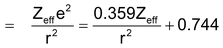 , Zeff = Z - σ
Z = The actual number of charge present on the nucleus i.e number of protons σ = Shielding constant
Factors Affecting the Magnitude of Electronegativity:
- Atomic radius: As the atomic radius of the element increases the electronegativity value decrease.

- Effective nuclear charge: The electronegativity value increases as the effective nuclear charge on the atomic nucleus increases.
Electronegativity α Effective nuclear charge (Zeff)
- Oxidation state of the atom: The electronegativity value increases as the oxidation state (i.e. the number of positive charge) of the atom increases.
- Hybridization state of an atom in a molecule: if the s- character in the hybridization state of the atom increases electronegativity also increases because s-electrons are having more penetration effect. For example the electronegativity values of C-atom in various hybridization states are as under —
Hybridization states sp3 sp2 sp
s-Character 25% 33.33% 50%
Electronegativity 2.48 2.75 3.25
⎯⎯⎯⎯⎯⎯⎯⎯⎯⎯⎯⎯⎯⎯⎯⎯⎯⎯⎯⎯⎯⎯⎯⎯⎯⎯→
s-character is increasing
So the electronegativity value is increasing
PERIODICITY IN ELECTRONEGATIVITY
- In a period moving from left to right, the electronegativity increases due to the increase in effective nuclear charge.
- In a period the electronegativity value of IA alkali metal is minimum and that of VIIA halogen is maximum.
- In a group moving from top to bottom, the electronegativity decreases because atomic radius increases.
- The electronegativity value of F is maximum and that of Cs is minimum in the periodic table.
- The electronegativity of Cs(55) should be more than Fr(87) but it is less. This is due to the increase of +32 units in nuclear charge of Fr which makes the effective nuclear charge comparatively high.
- On moving from second to third transition series in a group [except Y(39) → La(57)] electronegativity increases due to the increase of +32 units in nuclear atoms.
- The electronegativity of inert gas elements (zero group) is zero due to stable ns2np6 configuration. Inert gases are monoatomic molecules and the electronegativity is the property of bonded atoms.
Applications of Electronegativity:
- Partial ionic character in covalent Bond: The ionic character of a covalent bond increases as the electronegativity difference of bonded atoms increases. According to Haney and Smith if the electronegativity difference of bonded atoms is Δx then.
Ionic character percentage of the bond =16Δx+3.5Δx2
If the value of Δx is 1.7 then ionic character percentage is about 50. For example the order of ionic character in H–X bond is as follows–
H–F > H–Cl > H–Br > H–I
Because the electronegativity difference of bonded atoms (Δx) decreases.
- Bond strength If the electronegativity difference of covalently bonded atoms (Δx) increases, the bond energy of the covalent bond also increases. For example – the order of the H–X bond strength is
- H– F > H–Cl > H–Br > H–I
As the bond strength is decreasing the acid strength is increasing. So order of increasing acid strength is HF < HCl < HBr < HI
- Acidic and basic nature of oxides of normal elements in a period: The acidic nature of the oxides of normal elements increases as we move from left to right in a period. In a period from left to right the electronegativity of the elements increases. So the difference of the electronegativities of Oxygen and the elements (x0 –xE) decreases. If the (x0 – xE) values is about 2.3 or more then oxide will be basic. If (x0 – xE) values is less than 2.3 the oxide will be acidic. The oxides of the IIIA elements are amphoteric.
The order of acidic or basic nature of the oxides of third period elements may be given as under
Na2O MgO SiO2 P2O5 SO3 Cl2O7
⎯⎯⎯⎯⎯⎯⎯⎯⎯⎯⎯⎯⎯⎯⎯⎯⎯⎯⎯⎯⎯⎯
The value of x0 – xE is decreasing
Basic nature is decreasing
Acidic nature is increasing
Metallic and non metallic properties of elements:
(a) The metallic character decreases as the electronegativity of the element increases
(b) On moving from left to right in a periods, the electronegativity of the elements increases. So the metallic character decreases.
(c) On moving down a group, the electronegativity of the elements decreases. So the metallic character increases.
Basic nature of the hydroxides of elements:
A hydroxide MOH of an element M may ionize in two ways in water.
M–O–H + H2O  MO– + H3O+ …….(1)
M–O–H +H2O MOH2+ + OH– …… (2)
If the ionization is according to eqn (1) then it is acidic. It is possible when ionic character of O–H bond is more than the ionic character of M-O bond i.e. x0 – xH > x0–xM where x0, xH and xM are the electronegativities of oxygen, hydrogen and element respectively. If the ionization is according to eqn. (2) then it is basic. This is possible only when ionic character of O –H bond is less than M–O bond i.e x0 – xH <x0 –xM



