






Mendeleev's Periodic Table
Periodic Properties of Class 11
Mendeleev discovered 63 elements in the periodic table into 7 horizontal rows known as periods and 8 vertical columns known as groups numbered 1 to 8. When all the chemical elements are arranged, and there is a recurring pattern known as “periodic law” in their properties, in which all the elements in the same column (group) have similar properties. In the mid-19th century, the initial discovery, which was made by Dmitry. Mendeleyev has been of inestimable value in the development of chemistry.
| Table of Content |
What is a Periodic Table?
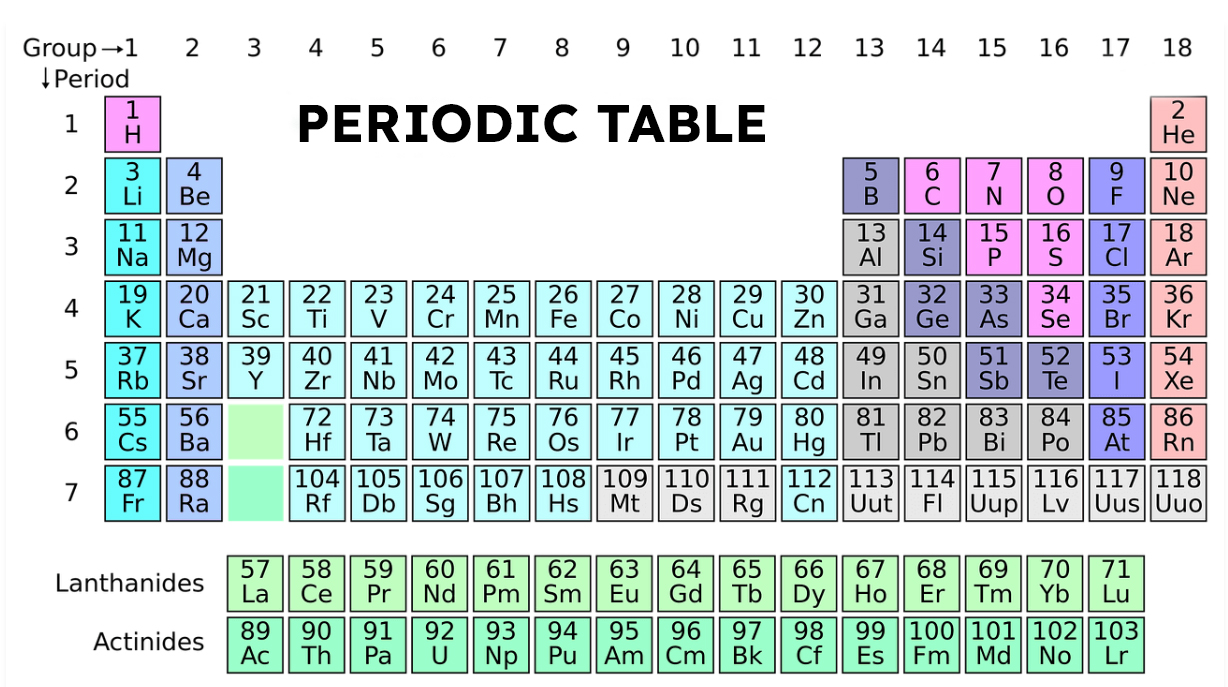
A periodic table is an arrangement of all elements known to man according to their increasing atomic number and recurring chemical properties. They are arranged in a tabular arrangement where a row is a period, and a column is a group.
The elements are arranged from left to right and top to bottom in increasing order of atomic numbers. Therefore,
- Elements in the same group that have the same configuration of valence electrons and, therefore, similar chemical properties.
- While elements in the same period will have increasing order of valence electrons. Therefore, as the energy level of an atom increases, the number of energy sublevels per energy level increases.
The first 94 periodic table elements occur naturally, while the remaining 95 to 118 have only been synthesized in laboratories or nuclear reactors.
The modern periodic table we use now is a new and improved version of certain models put forward by scientists in the 19th and 20th centuries. Dimitri Mendeleev presented his periodic table based on the findings of some scientists before him, such as Antoine-Laurent de Lavoisier and John Newlands. Thus, Mendeleev is given sole credit for his development of the periodic table.
Mendeleev Periodic Table
Dimitri Mendeleev, who is widely regarded as the father of the periodic table, came up with the first iteration of the periodic table that is similar to the one we use now. Mendeleev's periodic law differs from the modern periodic law in one significant aspect.
- Mendeleev modeled his periodic table based on increasing atomic mass, while the modern periodic law is based on increasing the order of atomic numbers.
Although Mendeleev's periodic table was based on atomic weight, he could predict the properties and discovery of specific elements. Only about half of the elements we know now were known during his time, and most of the information about all elements was inaccurate. Mendeleev's periodic table was published in the German Journal of chemistry in 1869.
Mendeleev Suggested
- He excluded certain elements and assigned them a separate independent position.
- Leaving gaps for the then undiscovered elements
- When the properties of elements did not correspond to what is expected of the group they were named by prefixing Eka to the preceding element e.g. Eka boron (Silicon); Eka silicon (Germanium), Eka aluminum (Gallium); Eka Maganese (Technitium)
Uses of Mendeleev Periodic Table
- Systematic study of the elements
- Atomic weights of elements were determined with the help of periodic table. Atomic weight = Valency × Equivalent weight = Group number × Equivalent weight.
- Atomic weights of elements were corrected. Atomic weight of Be was calculated to be 3 × 4.5 = 13.5 by considering its valency 3. Mendeleev calculated it 2 × 4.5 = 9.
- Discovery of new elements – In Mendeleev's periodic table two consecutive members differs by two or three units in the atomic weight. Where this gap was more, the gaps were left in the periodic table.
Defects of Mendeleev Periodic Table:
- The Position of hydrogen is uncertain. It has been placed in IA and VIIA groups because of its resemblance with both the groups.
- No separate positions are given to isotopes.
- It is not clear to which group lanthanides and actinides belong to.
- Although there is no resemblance except valency of subgroups A and B, they have been put in the same group.
- The order of increasing atomic weights is not strictly followed in the arrangement of elements in the periodic table. For e.g. – Co (At.wt. 58.9) is placed before Ni (58.7) and Ar (39.9) is placed before K (39).
Frequently Asked Question (FAQs)
Q1. What are some fun facts about the periodic table?
Ans. Facts About the Periodic Table of Elements are mentioned below:
- Dmitri Mendeleyev is the founder of the modern periodic table.
- Scientists before used battery polarity to weigh the elements.
- The periodic table reflects its creator love for card games.
- It used to correctly predict elements that hadn't been discovered.
Q2. Why is the periodic table so called?
Ans. A periodic table is called so because of how the elements are arranged. All the elements are arranged in horizontal rows and columns (called periods). Some of the chemists noticed that the general physical and chemical properties of the elements repeated periodically.
Q3. How did the periodic table get its name?
Ans. It is called the periodic table because of how the elements are arranged. You'll notice they're always in both columns and rows. The vertical columns (which go from up to down) are called 'groups,' and the horizontal rows (going from left to right) are called 'periods.'
Q4. What is the oldest element?
Ans. The oldest element is Phosphorus.
Q5. What are all elements made of?
Ans. All elements are made up of atoms. Atoms are made up of electrons, neutrons, and protons. Two different kinds of atoms can combine to form a compound. An molecule is a combination of atoms that cannot be broken apart while retaining the same properties as the larger substance it is a part of.


