






Some More Special Type of Matrices

Share
Some More Special Type of Matrices
Matrices and Determinants of Class 12
Some More Special Type of Matrices
(i) Symmetric Matrix
A matrix A = [aij] n×n is symmetric if A = A′. Note that aij = aji for such a matrix, ∀ 1 ≤ i, j ≤ n.
(ii) Skew Symmetric Matrix
A matrix A = [aij]n×n is skew symmetric if A = – A′. Note that aij = –aji for such a matrix, ∀ 1 ≤ i, i ≤ n. If i = j, then aii = –aii ⇒ aii = 0. Thus in a skew symmetric matrix diagonal entries are zeros.
Note that every square matrix can be written (uniquely) as the sum of a symmetric and a skew symmetric matrix, i.e., A = 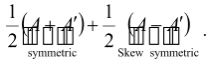 .
.
(iii) Hermitian Matrix
A matrix A = [aij]n×n is hermitian if A* = A. Note that aij =  ji for such a matix. Thus in a skew hermitian matrix aii = ii ⇒ diagonal entries of a hermitian matrix are real.
(iv) Skew Hermitian Matrix
A matrix A = [aij]n×n is skew hermitian if A* = –A.
Note that aij = –ji. Thus in a hermitian matrix aii = –ii ⇒ diagonal entries of a skew hermitian matrix are either zero or purely imaginary.
Note that every square matrix can be written (uniquely) as the sum of a hermitian and a skew–hermitian matrix i.e., 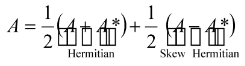 .
.
(v) Orthogonal Matrix
A matrix A = [aij]n×n is orthogonal if AA′ = In. Thus in a 3 × 3 orthogonal matrix rows (columns) are forming orthogonal system of unit vectors and vice versa. For example 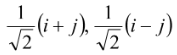 and
and  are forming orthogonal system of unit vectors. The corresponding matrix is
 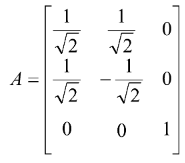 .
.
Note that AA′ = I3. Thus A is an orthogonal matrix.
(vi) Unitary Matrix
A matrix A = [aij]n×n is unitary if AA* = In. For example the matrix 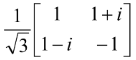 is unitary.



