







The human ear
Sound of Class 8
THE HUMAN EAR
Hearing is a sense endowed to us, because of the presence of the human auditory system. This auditory system offers us the ability to understand sound by detecting vibrations in the surrounding medium. The vibration, as mentioned, consists of minute pressure variations. We are now going to take a closer look at how this can be achieved.
CONSTRUCTION OF HUMAN EAR:
The ear consists of three compartments: outer ear, middle ear and inner ear.
The part of ear which we see outside the head is called outer ear. The outer ear consists of broad part called pinna and about 2 to 3 centimeters long passage called ear canal. At the end of ear canal, there is a thin, elastic and circular membrane called ear-drum. The ear-drum is also called tympanum. The outer ear contains air. The middle ear contains three small and delicate bones called hammer, anvil and stirrup. These ear-bones are linked to one another. One end of the bone called hammer is touching the ear-drum and its other end is connected to the second bone called anvil. The other end of anvil is connected to the third bone called stirrup and the free end of stirrup is held against the membrane over the oval window of inner ear. The middle ear also contains air. The lower part of middle ear has a narrow tube called `eustachian tube' going to the throat. Eustachian tube connects the middle ear to throat and ensures that the air pressure inside the middle ear is the same as that on the outside.
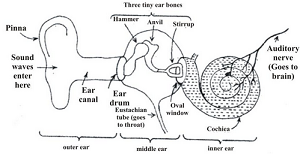
The inner ear has a coiled tube called cochlea. One side of cochlea is connected to the middle ear through the elastic membrane over the oval window. The cochlea is filled with a liquid. The liquid present in cochlea contains nerve cells which are sensitive to sound. The other side of cochlea is connected to auditory nerve which goes into the brain.
WORKING OF HUMAN EAR:
The sound waves (coming from a sound producing body) are collected by the pinna of outer ear. These sound waves pass through the ear canal and fall on the ear-drum. Sound waves consist of campressions (high pressure regions) and rarefactions (low pressure regions). When the compression of sound wave strikes the ear drum, the pressure on the outside of ear-drum increases and pushes the ear drum inwards and when the rarefaction of sound wave falls on the ear drum, the pressure on the outside of ear drum decreases and it moves outward. Thus, when the sound waves fall on the ear drum, the eardrum starts vibrating back and forth rapidly.
The vibrating ear drum causes a small bone hammer to vibrate. From hammer, vibrations are passed on to the second bone anvil and finally to the third bone stirrup. The vibrating stirrup strikes on the membrane of the oval window and passes its vibrations to the liquid in the cochlea. Due to this, the liquid in the cochlea begins to vibrate. The vibrating liquid of cochlea set up electrical pulses in the nerve cells present in it. These electrical pulses are carried by auditory nerve to the brain. The brain interprets these electrical pulses as sound and we get the sensation of hearing.
Further Reading:
1. Noise


Have questions about your prep?
Our experts can answer all your questions