






Some Important Conclusions
Light of Class 10
On the basis of the New Cartesian Sign Convention discussed above, we can draw the following conclusions for the spherical mirrors (concave as well as convex mirrors).
IN THE CASE OF CONCAVE MIRROR:
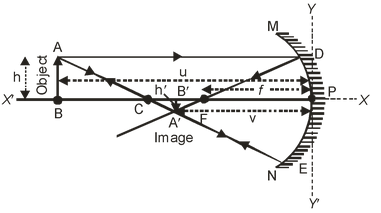
(i) For real and inverted image
|
|
|
|
In the case of a concave mirror, for real and inverted image, only object height (h) is +ve, and the remaining all distances are –ve. |

(ii) For virtual and erect image
|
|

|
|
In the case of a concave mirror, for virtual and erect image, object distance (u) focal length (f), radius of curvature (R) are –ve and the remaining all distances are +ve. |
IN CASE OF CONVEX MIRROR
|
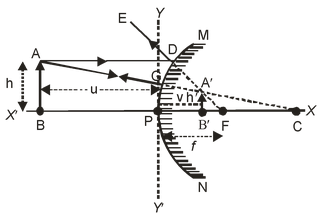
A convex mirror always forms a virtual and erect image. Therefore for virtual and erect image:
|
|
|
|
In the case of a convex mirror, for virtual and erect image, only object distance (u) is –ve and the remaining all distances are +ve. |
1. The radius of curvature of a spherical mirror is 20 cm. What is its focal length?
Solution: Focal length, f = Radiuns curvatures(R)/2
⇒ f = 20/2 = 10 cm.
2. Explain why, convex mirrors are used as rear-view mirrors in vehicles.
Solution: Convex mirrors are preferred as rear-view mirrors because of two reasons :
(a) A convex mirror always produces an erect (right side up) image of the objects.
(b) The image formed in a convex mirror is highly diminished or much smaller than the object, due to which a convex mirror gives a wide field of view (of the traffic behind). A convex mirror enables a driver to view much larger area of the traffic behind him than would be possible with a plane mirror. A plane mirror gives a narrow field of view.



