






Lymph

Share
Lymph
Animal Tissues of Class 11
- Colourless fluid without RBC and platelets.
- Mainly composed of plasma and leucocytes (mostly lymphocytes)
- Formed by a process of filtration of colloidal substances, salts and water from blood capillaries into the tissue spaces.
- The protein content is low and contains less fibrinogen than plasma.
- Acquires waste end products from tissue metabolism.
- Lymph capillaries present in the intestinal villi are called lacteals. These carry fats
Functions
Lymph returns blood proteins from tissue fluids to the blood and maintains the turgor of the intercellular spaces.
Lymph acts as a “middle man” which transports oxygen, food materials, hormones etc., to the body cells and brings carbon dioxide and other metabolic wastes, from the body cells to
blood and then finally pours the same into the venous system.
Body cells are kept moist by lymph.
Lymph nodes produce lymphocytes.
Destroys the invading micro-organisms and foreign particles in the lymph nodes.
Maintains the volume of the blood.

- When a blood vessel is ruptured, the blood loss is prevented by blood clotting or blood coagulation.
- Blood clotting protects the organism against blood loss or haemorrhage.
- Clotting time is the time required for blood to coagulate. Under normal conditions it is 3 to 5 minutes.
- The blood clot is formed by a protein fibrinogen which is present in soluble form in the plasma and which is transformed to an insoluble network of fibrous material fibrin, by blood clotting.
- Blood clotting involves sequence of four stages resulting in the formation of thromboplastin, thrombin, fibrin and clot.
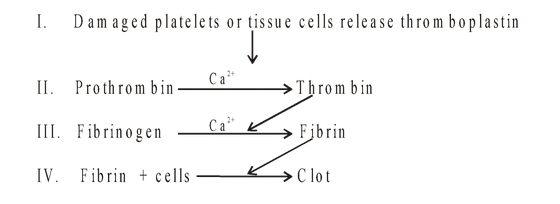
Stage I is concerned with the formation of thromboplastin released from damaged tissue or platelets. It helps in the formation of the enzyme thrombokinase.
Stage II involves the conversion of prothrombin into thrombin with the help of thrombokinase and calcium ions.
Stage III involves the conversion of a soluble protein fibrinogen in plasma to insoluble network of fibrous material called fibrin by the action of thrombin.
Stage IV is the formation of red solid mass called blood clot by trapping of blood cells particularly RBCs by fibrin network.
Blood plasma minus clot results in serum (pale yellow fluid oozing out from wounds).
Clotting in unbroken blood vessel (Intravascular) is called thrombosis.
A clot formed inside a vessel is called thrombus. Detached thrombus moving freely in blood is called emboli.
The Cascade Theory of Blood Clotting proposed by Macferlane.
Coagulation factors:
I Fibrinogen
II Prothrombin
III Thromboplastin
IV Calcium ions
V Proaccelerin (labile factor)
VI No factor at present (Hypothetical factor)
VII Serum prothrombin conversion accelerator (SPCA) (Stable factor) Proconvertin
VIII Antihaemophilic factor A (AHF, AHG)
IX Plasma thromboplastin component (PTC), Christmas factor, antihaemophilic factor B.
X Stuart - Prower factor
XI Plasma thromboplastin antecedent (PTA), antihaemophilic factor-C.
XII Hageman factor
XIII Fibrin - stabilizing factor, Laki-Lorand factor
HMW-K High molecular weight kininogen
Pre-K Prekallikrein
Ka Kallikrein
PL Platelet phospholipid
Anticoagulants
Any chemical substance that prevents the formation of clot is called an anticoagulant.
Anticoagulant removes cations to check coagulation.
Vitamin K is required for the synthesis of prothrombin necessary for blood clothing.
Dicumarol acts as an antagonist for the synthesis of prothrombin necessary for clotting.
CPD (Citrate Phosphate Dextrose), ACD (Acid Citrate Dextrose) and EDTA are used by blood banks to prevent blood samples from clotting.
Blood clotting can be prevented in a test tube by adding a little oxalate or citrate (Na and K). They bind free Ca++ ions of blood.
Hirudin is an anticoagulant present in the saliva of leech. Anophelin is present in saliva of female Anopheles.
Blood is stored with an anticoagulant at 4°C. At normal temperature due to potassium pump, K ions are more inside RBC than plasma. Low temperature stops the potassium pump i.e. -
inhibits active transport. K ions come out from RBCs resulting in ionic equilibrium.



