






Photorespiration
Photosynthesis In Higher Plants of Class 11
Photosynthetic Carbon Oxidation or PCO Cycle or C2 cycle
It was discovered by Dicker and Tio (1959) in Tobacco leaves. Subsequently, photorespiration was found to be universal in C3 plants. It involves three cell organelles - chloroplasts, peroxisomes and mitochondria. The various evidences in support of occurrence of photorespiration are
- Decrease in the rate of photosynthesis with the increase in light intensity.
- Decrease in the rate of photosynthesis when O2 concentration is raised from 2.5% to 21%.

Fig. Mechanism of photorespiration
Mechanism
RUBP carboxylase functions as RUBP oxygenase with the decrease in CO2 : O2 ratio
In photorespiration two molecules of phosphoglycolate formed by oxygenation of RUBP is changed to one molecule of RUBP is changed to one molecule of phosphoglycerate (PGA) and one molecule of CO2. Thus, 75% of carbon lost in oxygenation of RUBP is recovered by photorespiratory carbon oxygenation.
Photo respiration does not give any energy or reducing power. It consumes energy. So it is a wasteful process, especially in C3 plants but negligible or absent in C4 plants.
Photo respiration also increases with temperature and age of the leaf.
Glycine and serine are two amino acids formed in photorespiration or C2 cycle.
Hatch and Slack Cycle or C4 cycle
Kortschak, Hartt and Burr (1965) reported that rapidly photosynthesizing sugarcane leaves produced a 4-C compound like aspartic acid and malic acid as a result of CO2-fixation. This was later supported by M.D. Hatch and C.R. Slack (1966) and they reported that a 4-C compound oxaloacetic acid (OAA) is the first product in CO2 reduction process.
This led to an alternative pathway of CO2 fixation, which is known as Hatch and Slack’s cycle or C4 cycle (as 4-C compound is first stable product).
This pathway was first reported in members of family Gramineae (grasses) like sugarcane, maize, sorghum, etc., (Tropical grasses) but later on in other sub-tropical plants also like Atriplex and Amaranthus.
Genera like (Asteraceae) Flaveria panicum, Alternanthera and Atriplex contain both C3 and C4 species. These C4 plants have a characteristic leaf anatomy called Kranz anatomy (German word meaning : Wreath, Ring or Halo)
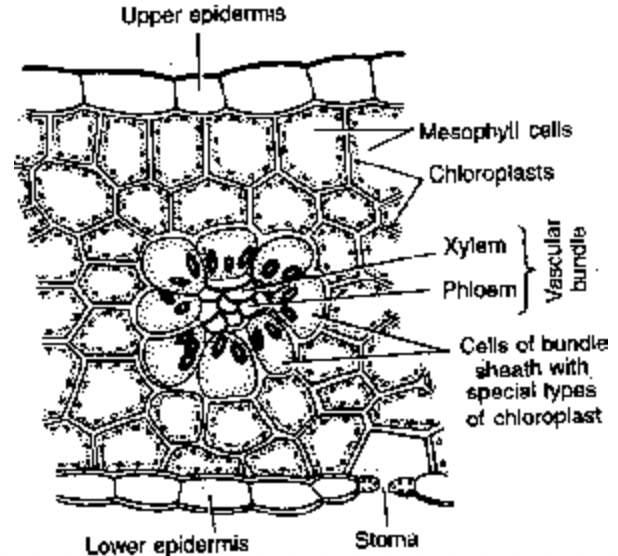
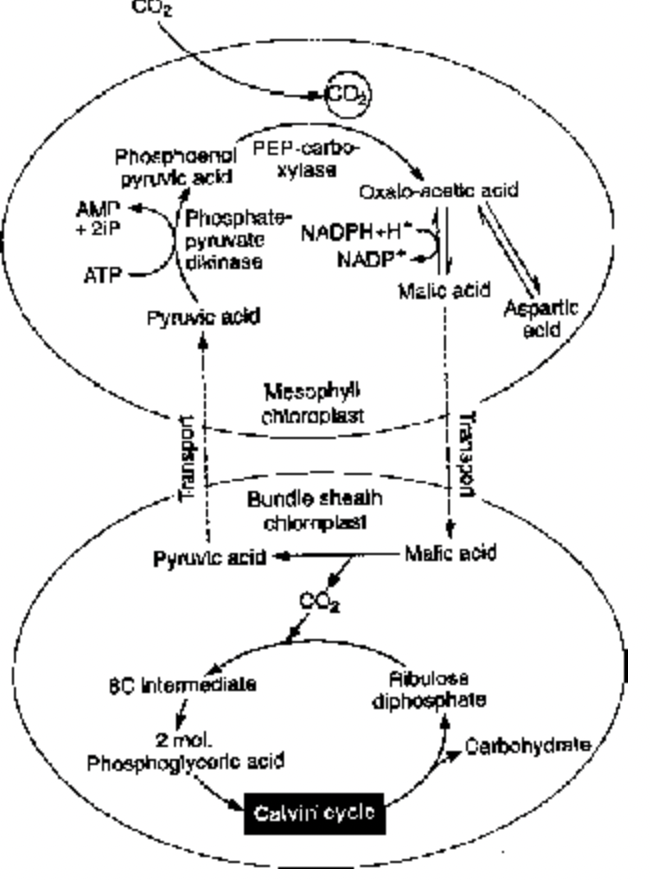
Fig. Leaf showing kranz anatomy Fig. Hatch and Slack’s cycle (C4 cycle)
Here vascular bundles are surrounded by sheath of large parenchymatous cells called bundle sheaths which are surrounded by mesophyll cells. Here two types of chloroplasts are present (Chloroplast Dimorphism)
(i) Bundle sheath chloroplasts : Larger in size, lack grana (Agranal choroplasts) and contain starch grains.
(ii) Mesophyll chloroplasts : Similar in size, contain grana (Granal chloroplasts) and lack starch grains. Bundle sheath cells and mesophyll cells are connected by plasmodesmata.
CO2 acceptor molecule here is PEP (Phospho Enol Pyruvate) and not RuBP. Further, PEP-carboxylase (PEPCO) is the key enzyme (RuBP-carboxylase enzyme is negligible or absent in mesophyll chloroplast, but present in bundle sheath chloroplast)
In C4 plants, for formation of one mole of hexose (glucose), 30 ATP and 12 NADPH2 are required.
Significance of C4 Cycle
This C4 cycle is helpful to plants growing in dense tropical forests, where there is poor supply of CO2. Because here there is internal supply of CO2, so these plants can survive in poor CO2 conditions. Photorespiration is negligible or absent in C4 plants and present only in C3 plants.



