Photosynthetic Pigments
Photosynthesis In Higher Plants of Class 11
Photosynthetic Pigments
Chloroplasts have two types of photosynthetic pigments, chlorophylls and carotenoids. Bacteria possess bacteriochlorophylls instead of chlorophylls. Phycobilins occur in some algae.
Chlorophyll a : The chlorophyll a has molecular formula as C55H72O5N4Mg and the molecular weight is 893. The molecule is distinguishable into a ‘head’ of size 15 x 15 Å and a ‘tail’ of 20 Å length. The ‘head’ is made up of porphyrin, a tetrapyrrole closed ring derivative and the ‘tail’ of phytol (C20H39OH). There is a 5th isocyclic ring of cyclopentanone. A non-ionic magnesium atom is held within tetrapyrrole ring by two covalent and two co-ordinate bonds. The chlorophyll a absorbs blue, yellow and red wavelengths of the spectrum.

Fig. Chemical structure of chlorophyll a
Chlorophyll b : Its molecular formula is C55H70O6N4Mg and the molecular weight is 907. It is similar to chlorophyll a except in having a formyl (CHO) group instead of methyl (CH3) at carbon-3 position of the second pyrrole ring. It absorbs blue and red wavelengths.
Chlorophyll c : Its molecular formula is probably C35H32O5N4Mg and the molecular weight is 721. It is found in brown algae, diatoms and also in Pyrrophyta and Cryptophyta.
Chlorophyll d : Its molecular formula is C54H70O6N4Mg the molecular weight is 895. It absorbs blue, yellow and red wavelengths of light. It is reported in red algae.
Chlorophyll e : The molecular formula and structure of this chlorophyll is not known. It has been reported from Xanthophyta.
Bacteriochlorophyll : (C55H74O6N4Mg), molecular weight - 911, found in purple-sulphur bacteria, absorbs light of 800, 850 and 890 nm wavelengths respectively.
Carotenoids : The carotenoids are unsaturated polyhydrocarbons. Light is not necessary for their biosynthesis. The carotenoid pigments include two classes of compounds namely carotenes and xanthophylls.
(i) Carotenes : Since they were first isolated from the roots of carrot by Wakenroder, hence the name carotene. These are orange coloured pigments having empirical formula as C40H56 and molecular weight, 536. They are found in all groups of plants i.e., from algae to Angiosperms. The -carotene on hydrolysis produce vitamin A hence the carotenes are also called provitamin A.
 (Vitamin A)
(ii) Xanthophylls : They are yellow coloured carotenoid also called xanthols or carotenols. These are oxygen containing carotenoids and are more abundant in nature. The ratio of xanthophyll to carotene in nature is 2 : 1 in young leaves. The most common xanthophyll in green plants is lutein (C40H56O2). In brown algae the brown pigment is fucoxanthin.
Phycobilins (biliprotein) : The phycobilins or more appropriately called phycobiliproteins comprise a bile pigment or phycobilin attached to a protein. The bile pigment shows an open chain tetrapyrrole structure. Three classes of biliproteins are recognised namely the phycoerythrin (red) phycocyanin (blue) and allophycocyanin (light blue). They are mainly found in red (Rhodophyceae) and blue-green (Cyanophyceae) algae.
Emerson Effect. While studying the effect of monochromatic light of different wavelengths on photosynthesis in Chlorella,Emerson (1957) found a sharp fall in quantum yield at wavelength more than 680 nm. The reduction in the rate of photosynthesis in monochromatic light of more than 680 nm is called red drop. The two types of monochromatic beams (Red light of wavelength shorter than 680 nm and red light more than 680 nm) were then applied simultaneously or in quick succession. The rate of photosynthesis was found to be quite high as compared to the sum of the rates of photosynthesis obtained with single beams. This is called as Enhancement Effect.
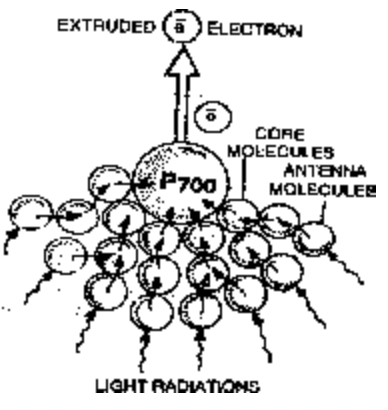
Photosynthetic Units. They are groups of pigment molecules which take part in photoconversion or change of light energy into chemical energy. Each photosynthetic unit has a reaction centre of special chlorophyll a molecule which absorbs long wave light energy. It is surrounded by a number of light harvesting pigment molecules. Harvesting pigment molecules are of two types, antenna and core molecules. (i) Antenna Molecules. They are pigment molecules that occur on the side of photosynthetic unit. Antenna molecules absorb photons of different wavelengths. They get excited. Energy is transferred to core molecules by electron spin resonance. (ii) Core Molecules are pigment molecules which lie around the trap centre. They take part in both direct light harvesting as well as transfer of energy from the antenna molecules. The energy gained by core molecules is passed on to reaction or trap centre. With the gain of energy, the reaction centre extrudes an electron.