






Translocation Of Solutes
Photosynthesis In Higher Plants of Class 11
Translocation Of Solutes and its conditions
A plant prepares food through its leaves. The leaves act as ‘supply end’ or source. It is then translocated to various parts of the plant body such as roots., tubers, fruits and other storage regions. These regions act as consumption end or sink.
Czapek found that phloem is the pathway of translocation of organic nutrients.
Girdling Experiments
Malpighi performed girdling or ringing of stems. A narrow ring of bark is removed below the foliage. Bark swells up above the ring. It may also develop adventitious roots. The swelling is due to accumulation of nutrients above the ring. This experiment proves that nutrients pass through phloem and not through the xylem.
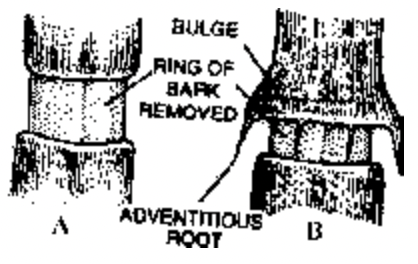
Fig. Girdling of tree trunk to show that organic nutrients accumulate in the bark above the girdle where a bulge is also produced
Hartig (1837): Discovered Sieve Tubes in the Bark
Autoradiography : Leaves were fed with radioactive . Sections were cut and autoradiographs were prepared. It was found that transport occured through the sieve tubes.
Transported solutes : The food is generally translocated as carbohydrate. The most dominant carbohydrate is sucrose. In some plants phloem sap contains raffinose, stachyose and mannitol.
Translocation rate : The sieve elements are 100 – 500 long and 20 – 40 in diameter. Average rate of translocation is 55 cms/hours.
Mechanism of Translocation
Several theories have been proposed to explain the mechanism of food translocation.
A. Diffusion hypothesis : Earlier workers believed that food is translocated from supply end to consumption end by simple diffusion. (Activated diffusion hypothesis — Mason and Maskel).
B. Protoplasmic streaming hypothesis : It was proposed by Hugo de vries. According to this theory the food is transported across by streaming current of protoplasm. This hypothesis explains the bidirectional movement of metabolites across a single sieve element.
C. Electro - osmotic hypothesis : This theory was proposed by Spanner. According to him the solute particles move electro-osmotically across the sieve plate through sieve pores.
D. Mass flow or pressure flow hypothesis :
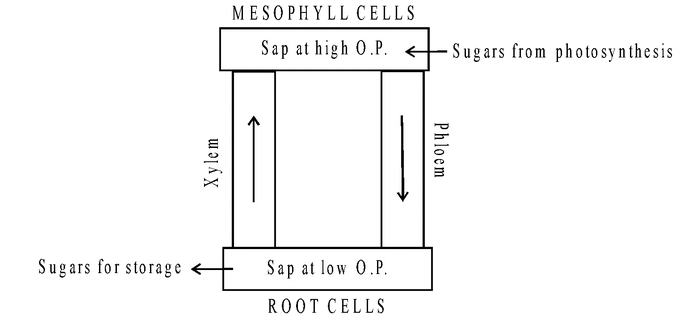
It was first proposed by Hartig and later modified by Munch. According to this hypothesis organic substances flow in solution form in the sieve elements due to development of pressure gradient between source and sink ends.
In plants, organic nutrients are synthesised in the mesophyll cells. From these cells nutrients enter into sieve tube elements which absorb water from the near by xylem elements. It produces a high turgor pressure that causes flow of nutrient solution in the sieve elements, towards the region where turgor pressure is low. In the sink region water moves back to xylem as O.P. is low due to utilisation of food or conversion to starch, therefore low T.P. is maintained at the sink end.
Objections of Mass Flow Hypothesis
- This theory explains only unidirectional movement of metabolites in a sieve element. Bidirectional movement of metabolities in a single sieve element has been observed which cannot be explained by this concept.
- According to this theory, the source must have a higher concentration than the sink. In many plants the reverse has been found.
- Deficiency of water do not affect the rate of translocation.
- Cytoplasm at the sieve plate impose resistance to mass flow.
Factors Affecting Translocation
- Temperature : The optimum temperature for translocation ranges between 20°C – 30°C. It increases with increase of temperature upto a maximum limit and then decreases.
- Minerals : It has been demonstrated that boron enhanced translocation of labelled sucrose in tomato.



