






Cell Size

Share
Cell Size
Structure of Cell of Class 11
Depending upon origin, cells are of three types:
(a) Prokaryotic cell e.g. bacteria, cyanobacteria, archaebacteria, Mycoplasma, Rickettsiae.
Size - 0.1 – 5µ; Volume 0.2 – 10 µm3; DNA : RNA ratio - 1 : 2.
They have only one envelope system. Membrane bound cell organelles are absent.
Circular DNA is not associated with histones.
Well defined nucleus absent. The clear nuclear area shows a tangled DNA called as nucleoid/genophore/prochromosome.
Amount of DNA remains constant throughout the life cycle.
Spindle apparatus not formed during cell division.
Cell membrane may be folded to form mesosome that acts as site of respiration.
Flagella if present are single-stranded.
Ribosomes typically of 70S size.
(b) Eukaryotic cell
Size 3 – 30 µ ; Cell volume 1000 – 10,000 µm3; DNA : RNA – 1 : 1.
Two envelope organisation.
True nucleus and intracellular compartments present.
Microbodies i.e. peroxisomes, glyoxysomes, lysosomes bounded by single membrane.
Nucleus, plastids, mitochondria are bounded by double membrane.
Organelles like ribosomes, centrioles, microfilaments are without membrane.
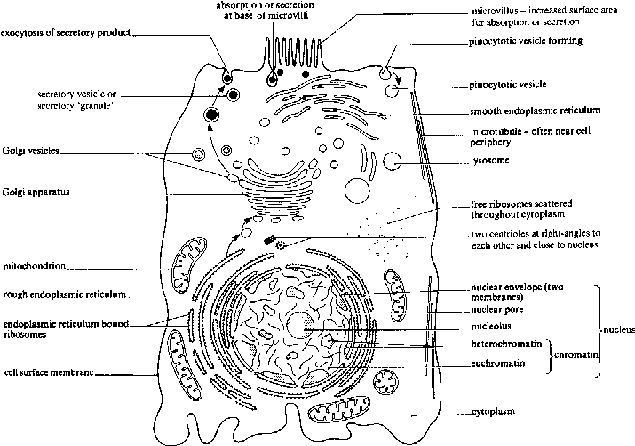
Fig. Ultrastructure of a generalised animal cell
Cytoplasmic Ribosomes-80S type and Organelle Ribosomes-70S type.
Flagella, if present, are 11-stranded.
Nuclear DNA associated with histone proteins.
Nuclear DNA linear. Extra-nuclear DNA circular.
Amount of DNA shows regular alteration between diploid and haploid stages.
Spindle apparatus produced during cell division.
(c) Mesokaryotic cell
Histone proteins absent but nucleus present.
Chromosomes are condensed in interphase.
Cell division by dinomitosis, e.g. Dinoflagellates.
Cell Sizes
Human RBC - 7 – 8 µm.
Unicellular eukaryote - 5 – 100 µm in size.
Human RBC and lymphocytes - 7-8 µm (smallest).
Human nerve cell - 90 cm long (largest).
Largest acellular plant Acetabularia - 10 cm long and animal Amoeba-1 mm.
Largest prokaryote Spirulina - 13 – 15 µm.
Fibres of ramie - 55 cm long and hemp fibres - 100 cm long.
Smallest prokaryotic cell Mycoplasma hominis (PPLO) - 0.1 – 0.3 µm in size.
Cell of multicellular eukaryote - 1 – 1000 µm in size.
Ostrich egg (Largest cell) is 15-20 × 13.5-15 cm in size. Ostrich egg is not considered as true cell as it stores a large amount of reserve food. Viruses do not have a cellular structure.
Unicellular and Multicellular Organisms
All primitive organisms are unicellular and later developed organisms are multicellular.
In unicellular organisms the single cell has to perform a large number of functions. It requires :
A large number of cell organelles (large volume) if it has to perform various life activities smoothly.
Large surface area for obtaining nourishment, elimination of waste products and exchange of gases.
With the increase in size of cells, the volume increases, surface area also increases but proportionately very small and the cell becomes inefficient.
Size of cell cannot grow beyond the efficient limits of surface area which is maintained by division of a grown-up cell.
Multicellular organisms vary in size from microscopic crustaceans to giant sized trees, elephants and whales. Large size is not due to larger size of cells but due to larger number of cells. The cells remain tiny and
it maintains their efficiency which is further enhanced by differentiation.



