






Centrioles

Share
Centrioles
Structure of Cell of Class 11
H.Fol (1873) discovered spindle fibres. Benden discovered centrosome. Centrosome is absent in higher plants.
Submicroscopic, microtubular, subcylindrical structures, which usually occur in the form of two granules, also called diplosomes inside a specialised cytoplasm called centrosphere or kinoplasm.
The complex formed of centriole and centrosphere was termed centrosome by Theodor Boveri (1888).
The two centrioles lie at right angle to each other and matrix fills the centrioles.
Each centriole has a cartwheel organization having a whorl of nine peripheral triplet fibrils of tubulin (9+0) tilted at an angle 40°. The three subfibres of a triplet from outside to inside are designated as, C, B and
A. The adjacent triplets are interconnected by proteinaceous linkers from C to A.
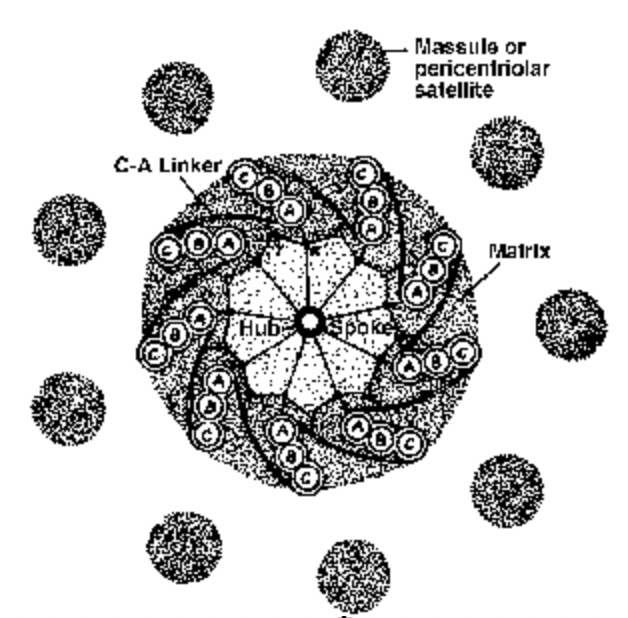
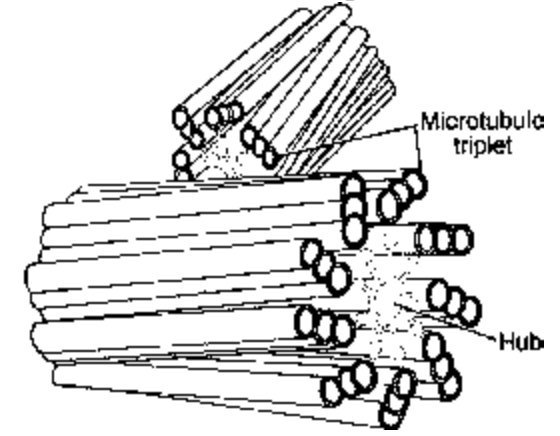
Fig. Ultrastructure of centriole as seen in T.S. Fig. Highly magnified centrioles
Though each subfibre is expected to have 13 protofilaments like microtubules, both C and A subfibres share 2-3 protofilaments with B subfibres.
The centre is occupied by a proteinaceous hub. The subfibre of each triplet is connected to the hub by means of radial proteinaceous strands called spokes. The spokes are also connected to C-A linkers with two
types of thickenings X and Y.
The centrioles are surrounded by dense, amorphous, protoplasmic spheres in one or more series called massules or pericentriolar satellites. These help in formation of new centrioles in G2 phase of cell cycle.
The centrioles are responsible for formation of basal bodies, cilia, flagella and astral spindle poles which are mostly present in animal cells and flagellated organisms and structures (like spores, and gametes, etc.) but they are absent in plants.
Centrioles are self duplicating units, contain DNA and RNA and are capable of protein synthesis.



