






Bleaching Powder

Share
Bleaching Powder
Inorganic Compound of Class 12
Bleaching Powder
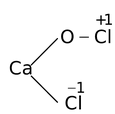
Bleaching powder is calcium chlorohypochlorite.
Preparation
(i) By passing Cl2 gas on slaked lime
Ca(OH)2 + Cl2 → 2 + H2O
Bleaching powder
Properties
(i) White powdered substance having little yellow ting, with smell of chlorine.
(ii) With acids (HCl, dil. H2SO4 etc) chlorine gas is evolved. Total amount of Cl2 gas evolved is known as available chlorine; (generally approx 35%)
CaOCl2 + 2HCl → CaCl 2 + H2O + Cl2
chlorine
Available chlorine is usually determined by Bunsen method and for this acetic acid is added to bleaching powder which liberates all chlorine.
CaOCl2 + 2CH3COOH → Ca(CH3COO)2 + H2O + Cl2
chlorine
Now, KI solution is added in excess the available chlorine from bleaching powder liberates equivalent amount of Iodine from KI.
2KI + Cl2 → 2KCl + I2
Iodine thus liberated forms brown colour complex with excess of KI
KI + I2 → KI3 [ KI.. I2]
Iodine bonded with KI is titrated against hypo (sodium thiosulphate) till brown colour disappears.
I2+ 2Na2S2O3 → 2NaI + Na2S4O6
Sodium Sodium
Iodide tetrathionate
(iii) With H2O (moisture) and CO2, Cl2 gas is liberated
CaOCl2+ H2O → Ca(OH)2 + Cl2
CaOCl2+ CO2 → CaCO3 + Cl2
(iv) In presence of COCl2(acts as catalyst) gives off O2
2CaOCl2 2CaCl2 + O2
(v) When heated with alcohol and acetone, chloroform is obtained which acts as anesthetic agent
CaOCl2 + H2O → Ca(OH)2 + Cl2
CH3CH2OH + Cl2 → CH3CHO + 2HCl
CH3CHO + 3Cl2 → CCl3.CHO + 3HCl
2C.Cl3CHO + Ca(OH)2 → 2CHCl3 + Ca(HCOO)2
chloroform



